How to attack a stimulus-based MCQ
Most of these questions are not really about history. They are about decoding what is being asked. Learn the four-step habit, then watch it worked step by step on a real Unit 8 test question. Use Back and Next to move through the highlighting.
Practice every unit on the full “Attack the Stimulus MCQ” page →
From the Iron Curtain to independence movements across Asia and Africa — master every concept and question before exam day.
Cold War & the End of Empire
The end of World War II in 1945 created a world simultaneously more unified — through the United Nations, the World Bank, and global institutions — and more bitterly divided. Two superpowers, the United States and the Soviet Union, emerged from the ruins of European hegemony with fundamentally incompatible visions of political and economic order. Their ideological conflict, conducted through proxy wars, arms races, and propaganda rather than direct confrontation, defined world politics for four decades.
At the same time, WWII had fatally weakened the European colonial powers. Britain, France, Belgium, and the Netherlands could no longer project the power needed to hold their empires. Between 1945 and 1975, over 80 new nations emerged from colonial rule across Asia, Africa, the Middle East, and the Caribbean. Decolonization was rarely peaceful — it often involved brutal wars of independence, Cold War interference, and difficult nation-building in the aftermath of arbitrary colonial borders.
The Cold War ended not with a bang but a series of revolutions — the fall of the Berlin Wall in 1989, the dissolution of the Soviet Union in 1991. What followed was not the "end of history" but an uncertain multipolar world in which the questions of economic justice, environmental sustainability, and political self-determination remained deeply unresolved.
Full Unit Video Review
A complete video walkthrough of Unit 8 — the Cold War, decolonization, and the global struggle between communism and capitalism, c. 1900–present.
The Story of the Cold War & Decolonization
Fourteen turning points from 1945 to 1991 — scroll to explore.
Key Terms & Concepts
Wait for the timer, think of the answer, then click the card to flip it. Navigate with the arrows or filter by topic.
Wait for the timer, then flip to check your answer · Use arrows to navigate
Write What You Know
Pick a topic, then write everything you remember for 5 minutes. When time’s up, we’ll show you all the content so you can compare.
Stimulus-Based Questions
AP-authentic questions using primary sources, speeches, and documents from Unit 8. Choose Quick Check for instant feedback, or Test Mode to answer a full set, rate your confidence, and reveal your score at the end — closer to real exam conditions.
Unit 8: Cold War & Decolonization
Click each topic to expand the full summary and key terms.
Mr. T’s FRQ Playbook
Everything you need to write the SAQ, DBQ, and LEQ on exam day.
📝 SAQ — Short Answer
Answer ONLY what is asked. No intros, no conclusions.
- Identify = 1–2 sentences
- Describe = 2 sentences
- Explain = 2–3 sentences with “because”
You must answer Q1 and Q2. Choose between Q3 or Q4 for the last one.
📄 Thesis Formula
Works for both DBQ and LEQ. Must be historically defensible with a line of reasoning.
Adverb evaluates extent: significantly, fundamentally, minimally, primarily…
🕐 Contextualization
A historical process that led to the topic.
- Don’t start at “the dawn of man”
- Stay within ~50 years of the prompt
- Must be 2–3 full sentences
- Explain HOW it connects to the prompt
📄 DBQ Evidence
- Points 1–2: Accurately use 4+ of 7 docs. Connect each to your argument.
- Point 3: Outside evidence — a real fact NOT in the documents
🔍 HAPP — Sourcing
Apply to at least 2 documents. Pick ONE element per doc.
Historical Situation
Audience
Point of View
Purpose
End with: “This alters/supports my understanding because…”
📝 LEQ — Long Essay
No documents — everything from memory.
- Causation: What caused / what resulted
- CCOT: What changed and stayed the same
- Comparison: Similarities and differences
✦ Explain both cause AND effect, or both similarity AND difference
✦ Connect across time periods or geographic areas
✦ Use all 7 documents effectively (DBQ) or HAPP 4+ documents
A counterargument paragraph can earn complexity — but only if it is a full paragraph with evidence, not just a sentence.
Visual Sources & HAPP Analysis
AP-authentic visual stimuli. Answer the AP question, then complete your HAPP analysis and compare to the model answer.
Reading the Maps
Maps are primary sources. Each one encodes choices about power, borders, and ideology — who drew the line, why there, and what it left out are AP-worthy questions every time.
NATO vs. Warsaw Pact: The Military Geography of the Cold War
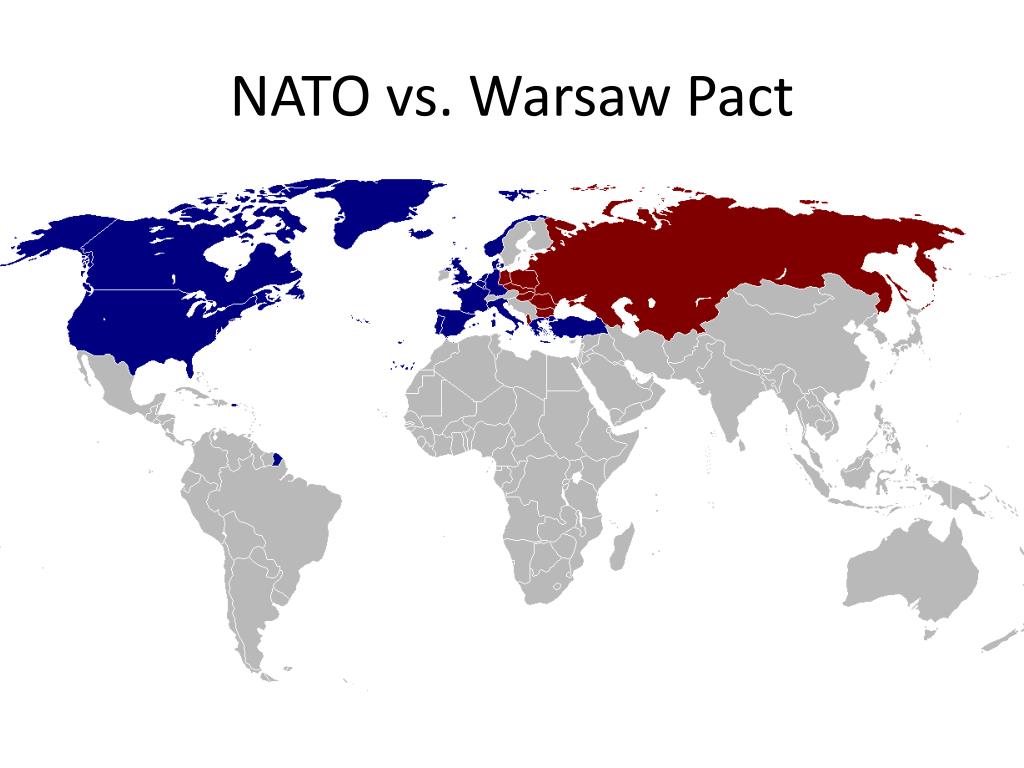
NATO (North Atlantic Treaty Organization) was founded in 1949; the Warsaw Pact formed in 1955 as the Soviet response when West Germany joined NATO. The two alliances faced each other across a militarized frontier in central Europe. Both operated on Article 5-style collective defense logic: an attack on one member is an attack on all. The map shows the geographic distribution of member states, with a crucial detail — neutral nations in between.
East vs. West: Europe Divided by the Iron Curtain
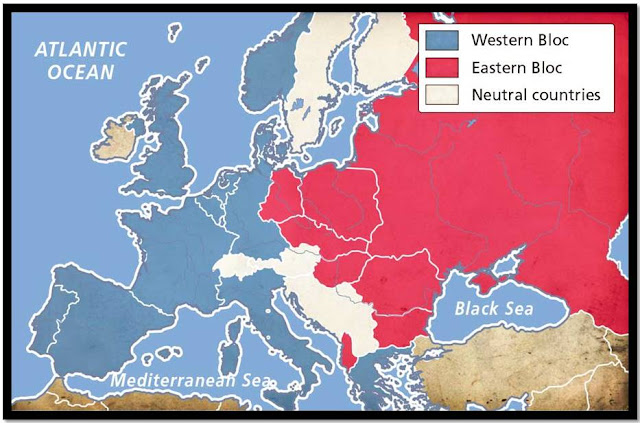
Churchill named it the "Iron Curtain" in his 1946 Fulton speech: "From Stettin in the Baltic to Trieste in the Adriatic, an iron curtain has descended across the Continent." The map shows the political and military division of Europe that defined the Cold War for 44 years. Western Europe (US sphere) was capitalist and democratic; Eastern Europe (Soviet sphere) was communist and authoritarian. The division was formalized at Yalta (1945) and hardened through the late 1940s.
The Partition of British India, 1947
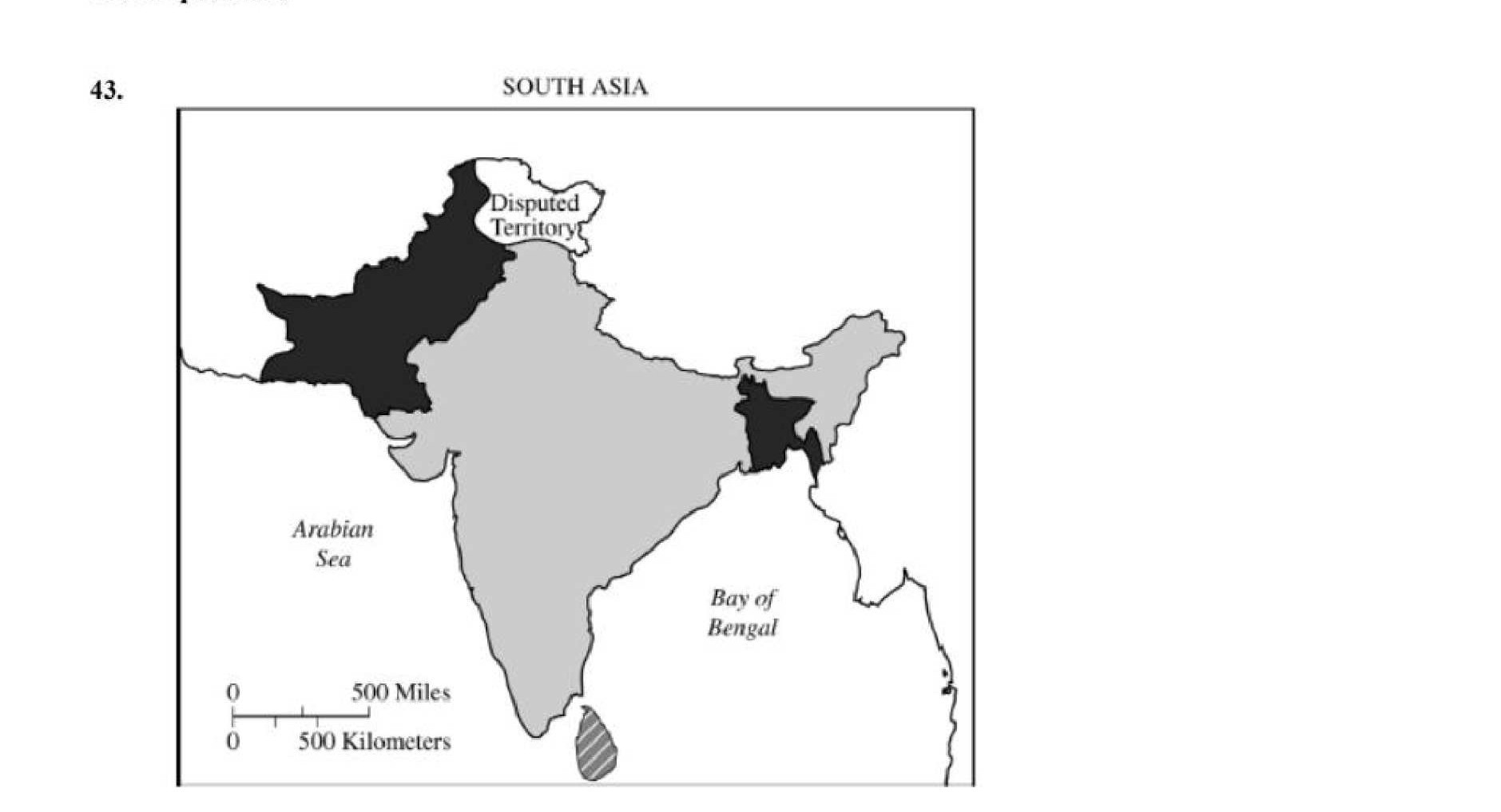
On August 14–15, 1947, British India was partitioned into two independent nations: India and Pakistan (which included what is now Bangladesh as East Pakistan). The Radcliffe Line — drawn by Sir Cyril Radcliffe, a British lawyer who had never visited India — divided Punjab and Bengal along religious lines. The decision was made in 73 days. The result: one of history’s largest forced migrations (10–15 million people) and communal violence that killed between 200,000 and 2 million.
Decolonization of Africa: 1930 and 1981
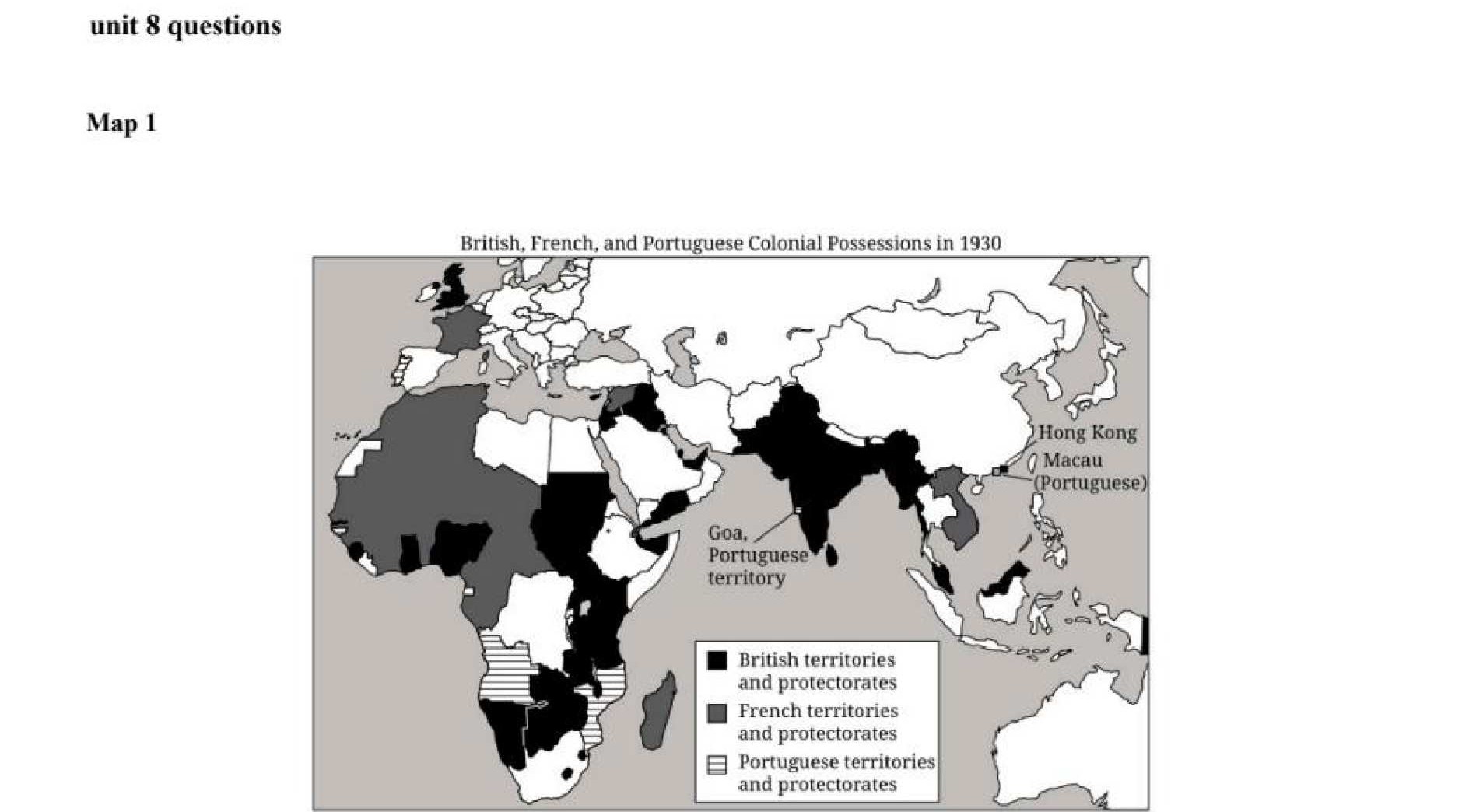
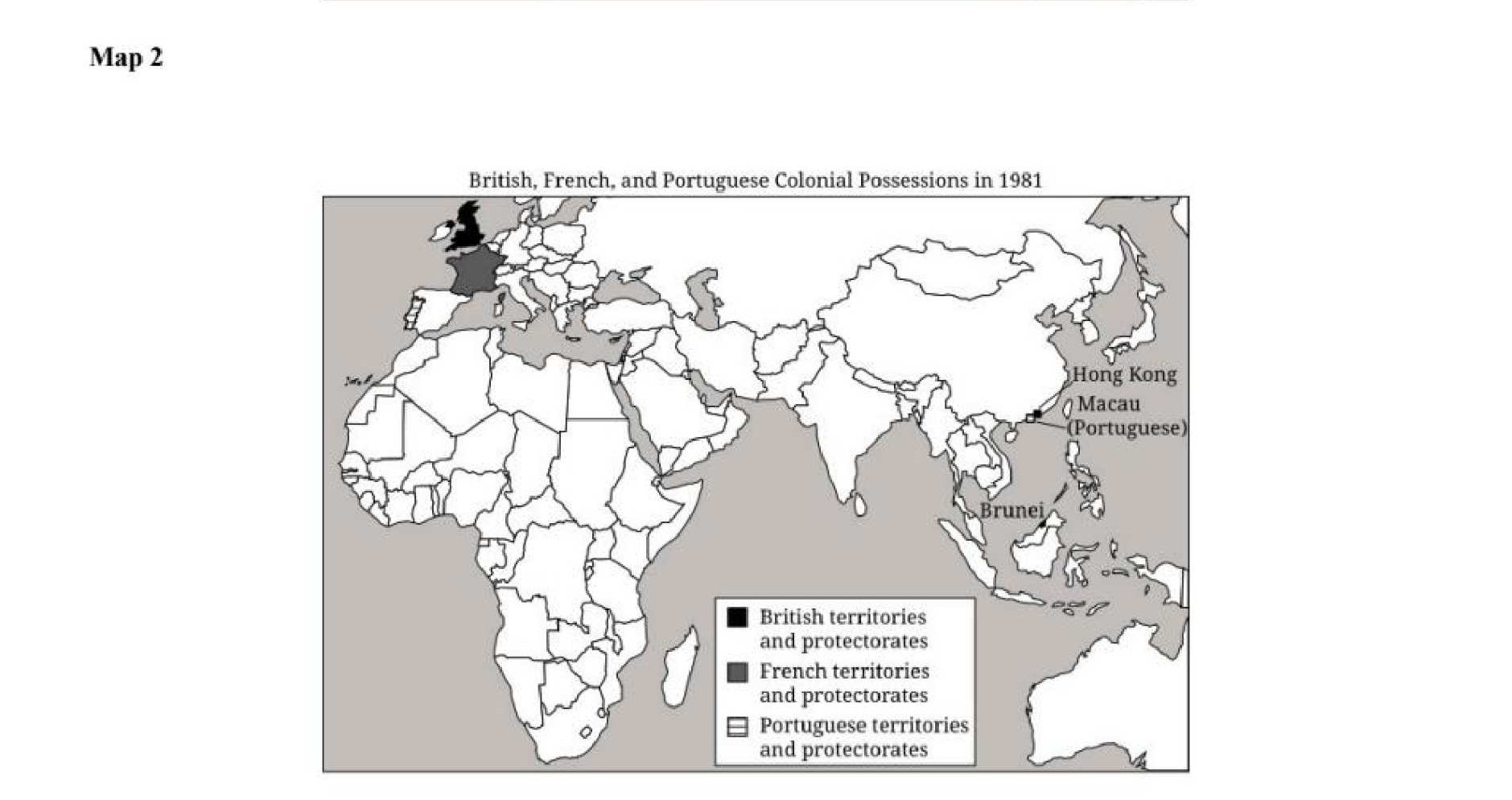
In 1930, virtually all of Africa was colonized by European powers: Britain, France, Belgium, Portugal, Italy, and Spain. Only Ethiopia and Liberia were independent. By 1981, over 50 sovereign African nations existed — nearly all created between 1956 and 1975, with 1960 alone producing 17 new nations ("the Year of Africa"). The transformation happened within a single human lifetime.
Test Your Knowledge
Choose a game mode to review Unit 8 with your class or on your own.
Go Beyond Identification
Don’t just name the source feature — explain why it matters. Practice the “since it was written by a… it may therefore…” move on documents from the DBQ on communism in the USSR and China, then compare to the model.
SPICE-T Analysis
Unit 8 — Cold War & Decolonization (c. 1900–present) through the AP World History thematic lens.
- Decolonization restructured social hierarchies across Asia, Africa, and the Caribbean
- US Civil Rights Movement (1950s–60s) challenged legal racial segregation with nonviolent protest
- Women’s liberation movements across the industrialized world demanded equal rights and political representation
- Cold War anxiety produced conformist suburban culture and anti-communist social pressure in the West
- Under Soviet communism, women entered the workforce in large numbers but retained domestic burdens
- Displaced persons and refugees from WWII and decolonization reshaped global migration patterns
- US and USSR competed ideologically (democracy vs. communism) without fighting each other directly
- NATO (1949) and Warsaw Pact (1955) divided Europe into opposing military alliance systems
- Korean (1950–53) and Vietnam (1955–75) wars were proxy conflicts between superpowers
- Non-Aligned Movement: newly independent nations tried to avoid alignment with either Cold War bloc
- Cuban Missile Crisis (1962) brought the world to the brink of nuclear war
- Soviet collapse (1991) ended the Cold War and broke the USSR into 15 independent states
- Nuclear weapons testing contaminated land and water in Nevada, Kazakhstan, and Pacific atolls
- Green Revolution (1960s) raised crop yields via new seed varieties but increased water and chemical use
- Soviet industrial buildup caused severe pollution; Aral Sea destruction became a symbol of ecological collapse
- Cold War proxy wars devastated the environments of Vietnam, Korea, Angola, and Afghanistan
- Space race opened new frontiers but required massive resource and energy consumption
- Environmental movements emerged in the 1970s in direct response to industrial and nuclear pollution
- Hollywood films and rock/jazz music served as US cultural soft power in the global Cold War
- Soviet Socialist Realism promoted communist ideology; Western abstract art was cast as decadent
- Decolonized nations developed new national identities through literature, music, and cultural institutions
- Television became the defining medium for culture, news, and propaganda in the Cold War era
- Student protest movements in 1968 challenged Cold War authority in both East and West simultaneously
- Liberation theology in Latin America blended Catholic social teaching with anti-poverty activism
- Marshall Plan (1948) funded Western European reconstruction and aligned recovering economies with the US
- Soviet command economy prioritized heavy industry and military over consumer goods and living standards
- OPEC oil embargo (1973) destabilized Western economies and revealed deep energy vulnerability
- Asian “economic miracle”: Japan, South Korea, Taiwan, and Singapore industrialized rapidly using export-led growth
- Third World debt crisis: IMF structural adjustment loans imposed painful austerity on developing nations
- Bretton Woods system established the US dollar as the global reserve currency and anchored world finance
- Nuclear weapons (ICBMs, hydrogen bomb) defined MAD deterrence strategy and reshaped global politics
- Space race produced satellites, GPS technology, and the moon landing (Apollo 11, 1969)
- Television transformed warfare: Vietnam became the “living room war,” shifting US public opinion
- Green Revolution agricultural technologies dramatically increased food production in the Global South
- Computers developed for military use; ARPANET (1969) was the direct precursor to the Internet
- Jet aircraft radically compressed global travel time and enabled rapid deployment of troops and cargo